Commercial
Vacant churches and synagogues offer multifamily investors a niche adaptive reuse play
By Real Estate Wire Staff, . Real Estate Wire.
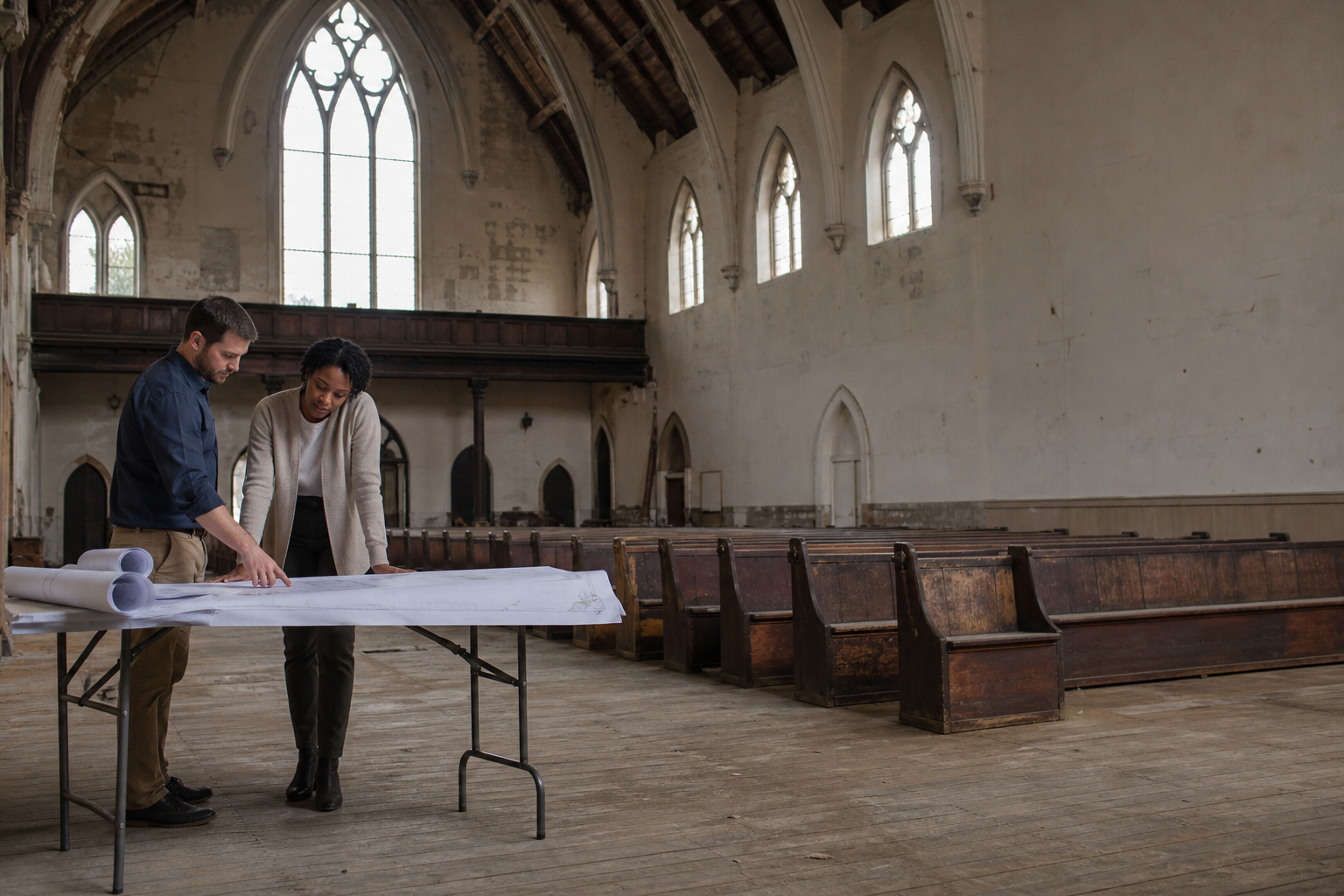
REJournals published a detailed look at the sanctuary-to-residential conversion market, written by Jon Morgan, co-founder and managing principal of Chicago-based Interra Realty. The core argument: former houses of worship sit at an unusual intersection of established urban locations, irreplicable architecture and a growing supply of surplus inventory.
The supply side is real, if hard to pin down precisely. A 2024 paper in the Journal for the Scientific Study of Religion, citing data from the 2020 U.S. Religion Census, estimates that roughly 1% of U.S. congregations close each year, which works out to approximately 3,500 closures annually. Most of those buildings will not pencil out for residential conversion, but the ones that do tend to share a common profile: infill urban locations where land assembly is difficult, proximity to transit and retail, and architectural character that a new build cannot match.
Morgan points to two Chicago transactions to illustrate the range. Interra is currently marketing 621 W. Belmont Ave. in Lakeview, a former parish house for St. Peter's Episcopal Church that was converted to 19 apartments in 2021. The second is a completed deal: in 2024, Interra brokered the sale of a former synagogue at 5029 N. Kenmore Ave. in Uptown for $8.175 million. That building had housed the Agudas Achim North Shore Congregation until 2008, was added to Preservation Chicago's annual "Chicago 7 Most Endangered" list before its conversion, and was redeveloped into 40 apartments in 2016 with neighbor and preservationist support.
The architectural upside is genuine. High ceilings, stone construction, arched windows and large open rooms create unit configurations that command a leasing premium over conventional product in the same submarket. Morgan is careful not to overstate it: because every property is so different, no universal premium can be established. The flip side is real too. Unusual floor plans are harder to furnish, very high ceilings push utility costs up, and leasing is less uniform across a building where no two units are alike. Experienced leasing teams can offset some of that with rendered furniture plans and unit-by-unit marketing, but the operational complexity is a genuine cost.
On the capital side, historic tax credits may apply depending on the property and are frequently folded into the capital stack. Conversions also return previously tax-exempt real estate to the property-tax rolls, which Morgan notes benefits the surrounding community by expanding the local tax base without requiring new land.
The piece situates religious conversions within the broader adaptive reuse conversation, comparing them to office and hotel conversions. Office-to-residential faces structural challenges from oversized floor plates and locations that often lack the amenities renters expect. Hotels convert more cleanly because plumbing is already stacked and in place. Religious buildings occupy a different position: the architecture is the asset, but it is also the constraint, and the strategy only works when character and fundamentals align.
The honest conclusion from the piece is that this is a niche, not a movement. The supply is fragmented, each building is its own underwriting problem, and the strategy cannot be replicated at scale. For investors willing to do the property-specific work, the reward is an asset that competitors cannot easily duplicate. But Morgan is explicit that character alone does not carry a deal: location, cash flow, cost control and exit value still have to be there.
With the Bureau of Labor Statistics reporting that rent of a primary residence rose 2.7% year on year as of August 2026, the broader multifamily market is not producing the kind of rent growth that papers over weak fundamentals. That makes the discipline Morgan describes more important, not less: a distinctive building in the wrong location, or with uncontrollable operating costs, does not get bailed out by the market the way it might have three years ago. The investors most likely to do well here are those who treat the architecture as a differentiator within a sound deal, not as a substitute for one.