Commercial
Mall values up 13% in a year, leading all commercial property sectors
By Real Estate Wire Staff, . Real Estate Wire.
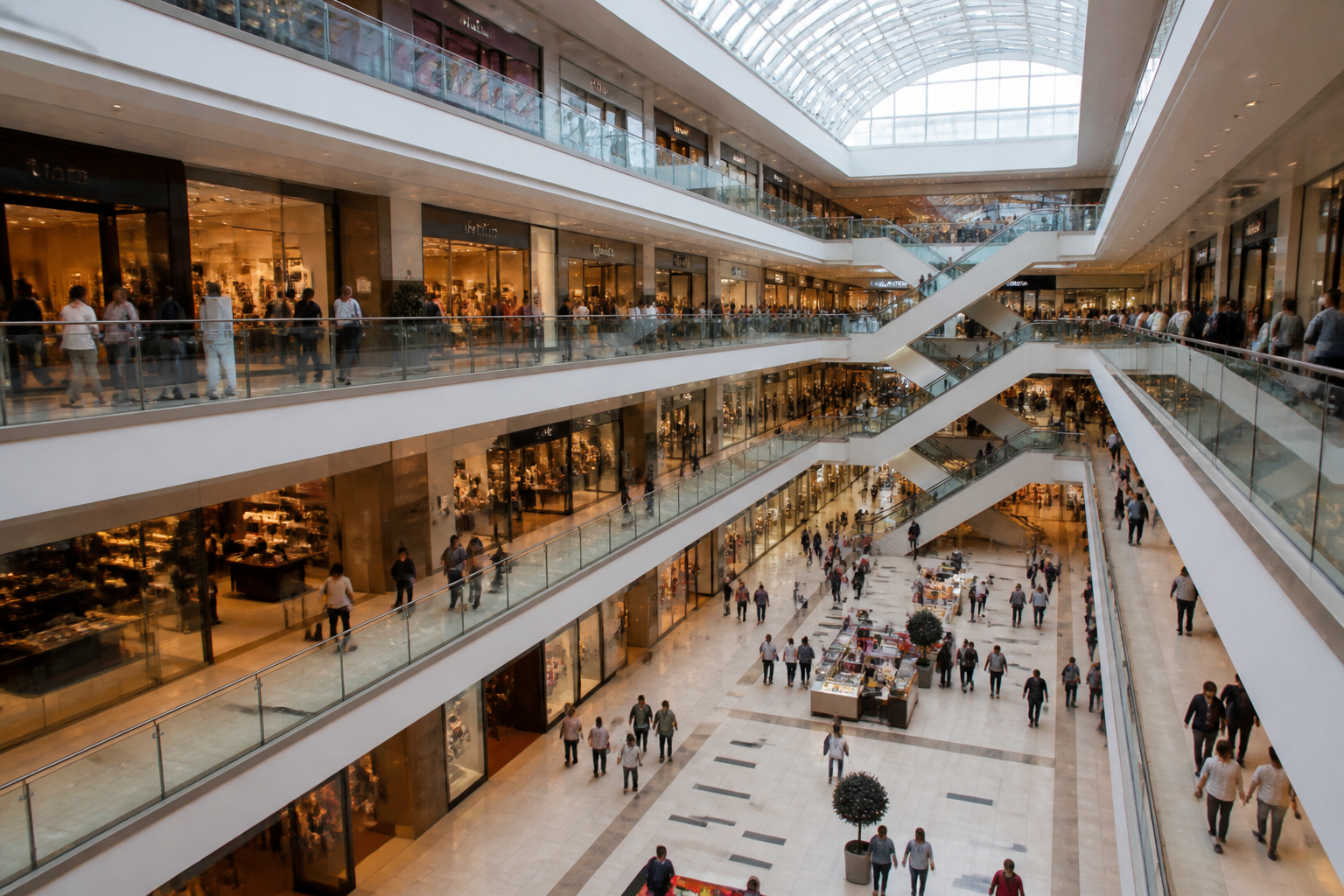
Mall property values rose 13% over the past year, outpacing every other commercial property sector and more than doubling the overall CRE price increase, according to Green Street data reported by Propmodo. The figure lands at a moment when the sector had been widely written off: roughly 200 malls have closed since 2008, and the pandemic accelerated a wave of retailer and mall-owner bankruptcies.
The investor signals are hard to ignore. Propmodo reports that shares of Simon Property Group, the country's largest mall owner, surpassed their 2016 record high in July and beat the S&P 500 over the past twelve months. Paris-based Unibail-Rodamco-Westfield, which announced plans to exit the U.S. market in 2021, reversed course and committed nearly $1 billion this year to buy out partners at two California malls. CBL Properties, which emerged from bankruptcy after the pandemic, has acquired five new properties since July 2025 and seen its stock price jump 48% this year, according to the same report.
The underlying drivers, as Propmodo describes them, are resilient consumer spending, few recent retailer bankruptcies, and a deliberate repositioning by mall owners who replaced struggling department store anchors with luxury retailers, restaurants and entertainment tenants less exposed to e-commerce pressure. Morgan Stanley's head of U.S. REIT and commercial real estate research told Propmodo that malls feel stronger fundamentally than at any point post-Covid. Occupancy and rent growth have held up better than multifamily and office, helped in part by the fact that new retail supply remains limited.
The recovery is not confined to flagship properties. Propmodo points to CBL's West County Center in St. Louis as a middle-market example: tenant sales rose 13% since 2023 after Nordstrom closed a competing location and Macy's renovated its anchor store. CBL now expects to refinance the property within 60 days, a notable turnaround given that the same mall's value had declined 30% over the prior decade and the company could not secure financing for it in 2022.
The cautionary notes in Propmodo's reporting are worth holding onto. Some investors argue that swapping department stores for restaurants and entertainment venues simply trades one tenant-replacement risk for another: if a restaurant group or entertainment operator closes, the replacement problem is no less acute. And mall values, despite the 13% annual gain, still sit well below their peak levels from a decade ago. The gap between current prices and prior highs means the sector is recovering, not restored.
What the reporting does not establish is how durable the consumer spending trend underpinning all of this actually is, or how the sector would perform if spending softens. The limited-supply argument is also worth watching carefully: it holds as long as no significant new retail development comes online, but it is a structural advantage that can erode. For investors and lenders who passed on mall exposure in 2022 and 2023, the CBL refinancing story is probably the most concrete near-term signal to track. If mid-tier malls can access capital again at reasonable terms, the recovery has legs beyond the trophy tier.